هذه المقالة غير متاحة بلغتك بعد. نعرض النسخة الإنجليزية.
Nestlé Waters Jordan: 14.7% lower energy per m³ through peak summer
At the Ma'an bottling plant, Denka® Platinum Plates reversed a 23.4% efficiency drift and avoided 134,693 kWh in July and August 2026.

Before installation, Nestlé Waters' Ma'an facility in Jordan was running 23.4% less efficiently than a year earlier: specific energy consumption (SEC) had risen from 37.74 kWh/m³ (H1 2025) to 46.58 kWh/m³ (H1 2026).
Denka® Platinum Plates went online on 1 July 2026 — at the start of the hottest months of the year.
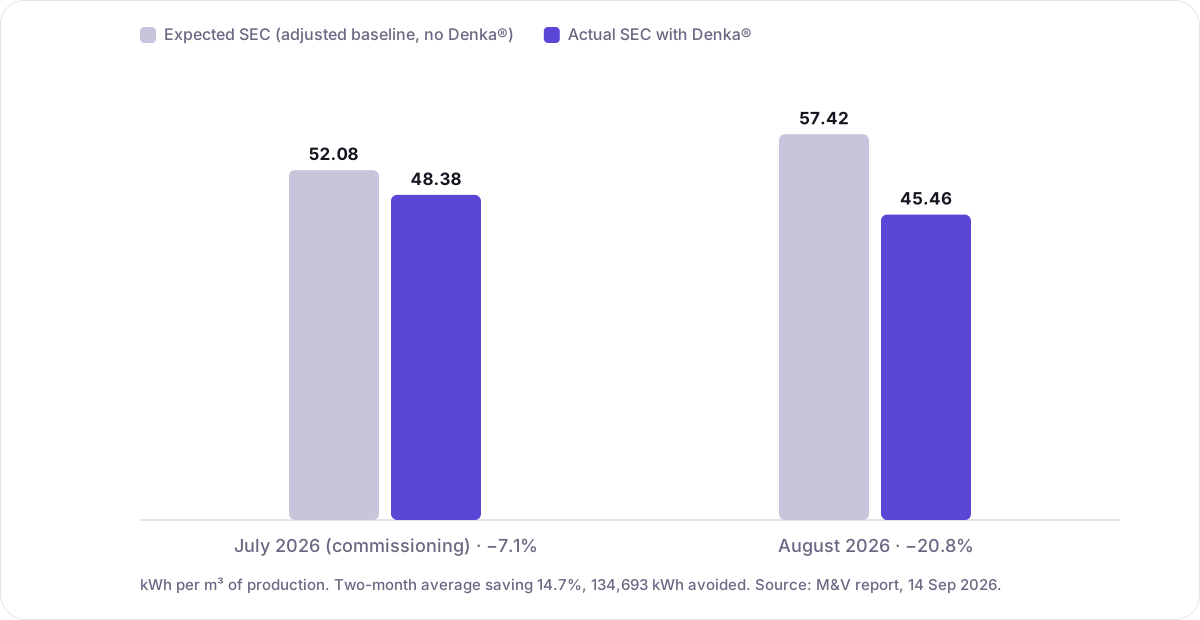 Expected SEC (adjusted baseline, without Denka®) vs actual SEC with Denka®. Source: M&V report, 14 Sep 2026.
The numbers
- July 2026 (commissioning): expected 52.08 → actual 48.38 kWh/m³ (−7.1%)
- August 2026: expected 57.42 → actual 45.46 kWh/m³ (−20.8%)
- Two-month average: 14.7% savings, 134,693 kWh avoided
How it was measured
The M&V uses SEC = facility kWh ÷ production m³, so changing volumes do not distort the result. The pre-installation degradation factor was applied to 2025 summer data to build a fair expected baseline for 2026. The M&V report has been confirmed by Nestlé Waters Jordan.
Transparent scope
These are the first two months of the reporting period. The consultant recommends extending measurement to September–October 2026 to confirm that savings stay stable into the autumn — and we publish that caveat with the result.