هذه المقالة غير متاحة بلغتك بعد. نعرض النسخة الإنجليزية.
Clip-on, zero rewiring: what a Denka® Plate installation day looks like
No shutdown of production lines, no galvanic connection, nothing to maintain. Where the plates go, who installs them and how long it takes.
One of the most common questions from operations teams: how disruptive is it? The short answer — far less than almost any other efficiency measure.
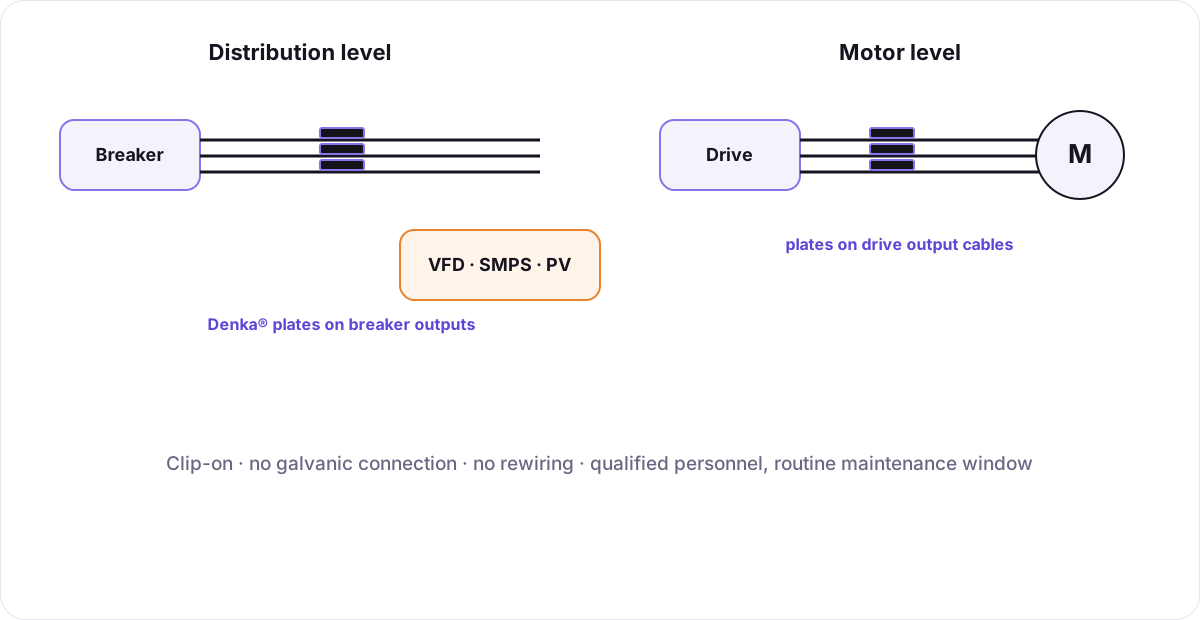 Distribution level (breaker outputs feeding non-linear loads) and motor level (drive output cables).
Before the day: the diagnostic
Engineers survey the HF noise spectrum, take thermal and power-quality baselines and log energy against production. The quantity comes from that site survey or the single-line diagram (SLD), panel by panel — there is no standard number, and very large plants can need thousands of plates.
The allocation rule. Only end-user panels — those whose breakers feed loads directly — are fitted, with 1 plate per phase conductor on each breaker of about 60 A and above. If every outgoing breaker in a panel is below 60 A, the principal breaker is fitted instead; if some are above and some below, the larger breakers are fitted individually and the principal covers the rest; if all are 60 A or more, every outgoing breaker is fitted and the principal is not.
On the day
- Safety first — qualified personnel work to local switchgear safety rules (for example NFPA 70E), during a routine maintenance window.
- Distribution level — plates clip onto the phase conductors at the outputs of breakers feeding VFDs, rectifiers, SMPS panels and PV inverters.
- Motor level — on large drives, plates go on the motor cables at the drive output, where they also reduce bearing currents.
- No connection — the plates are high-resistivity ceramic with no galvanic contact. Nothing is cut, terminated or rewired.
After the day
There is nothing to maintain: no consumables, no moving parts, no temperature rating to manage. The plates self-heat by no more than 0.4 °C while absorbing HF noise. Measurement then runs against the baseline — and the result is backed by the 90-Day Result-Conditioned Money-Back Guarantee.