هذه المقالة غير متاحة بلغتك بعد. نعرض النسخة الإنجليزية.
Cement plants: what SGS and plant engineers measured with Denka® Platinum
Two cement plants, two independent measurement approaches: ≈7.0% lower raw-mill kWh/t at Cleopatra Cement and 6.5–7.4% on Ciments d'Enfidha's kiln motors.

Cement is one of the most electricity-intensive industries on earth, and its mills and kilns are driven by large motors and variable-frequency drives — prime sources of HF conducted noise.
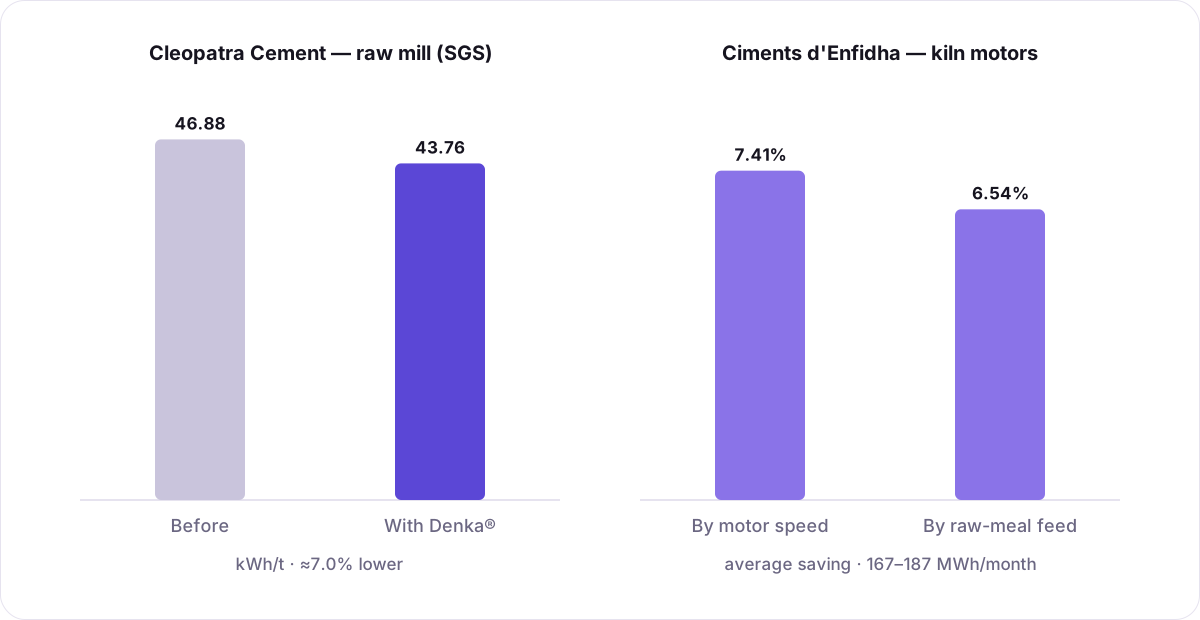 Left: Cleopatra raw-mill specific energy (SGS). Right: Ciments d'Enfidha kiln-motor savings by two calculation methods.
Cleopatra Cement, Egypt — measured by SGS
SGS measured raw-mill specific energy before and after installation under matched production:
- 46.88 → 43.76 kWh/t — about 7.0% lower
- 59% improvement in power-draw variance — a steadier, more predictable load
Ciments d'Enfidha (SCE), Tunisia — signed plant attestation
Plates were fitted at the last circuit breakers ahead of the kiln-workshop motors. The plant compared four weeks without plates (Nov–Dec 2021) with four weeks with plates (Apr 2022) using two independent methods:
- by motor speed: 7.41% average saving (6.66–8.16%)
- by raw-meal feed rate: 6.54% average saving (5.90–7.17%)
- 167–187 MWh saved per month in the kiln workshop
The result was confirmed in a signed attestation by the plant's Head of Electrical Service (13 September 2022).
Why it matters
On a 7% reduction, a mill drawing tens of GWh a year saves millions of kWh — with no rewiring, no consumables and a product life of 25+ years.