هذه المقالة غير متاحة بلغتك بعد. نعرض النسخة الإنجليزية.
Skin depth: why 30 MHz current uses only 12 µm of copper
At 50 Hz, current uses 9.2 mm of copper. At 30 MHz it is squeezed into 0.012 mm — and the AC resistance seen by that noise rises sharply.

Alternating current does not flow uniformly through a conductor. As frequency rises, it crowds towards the surface — the skin effect. The depth at which current density falls to of its surface value is
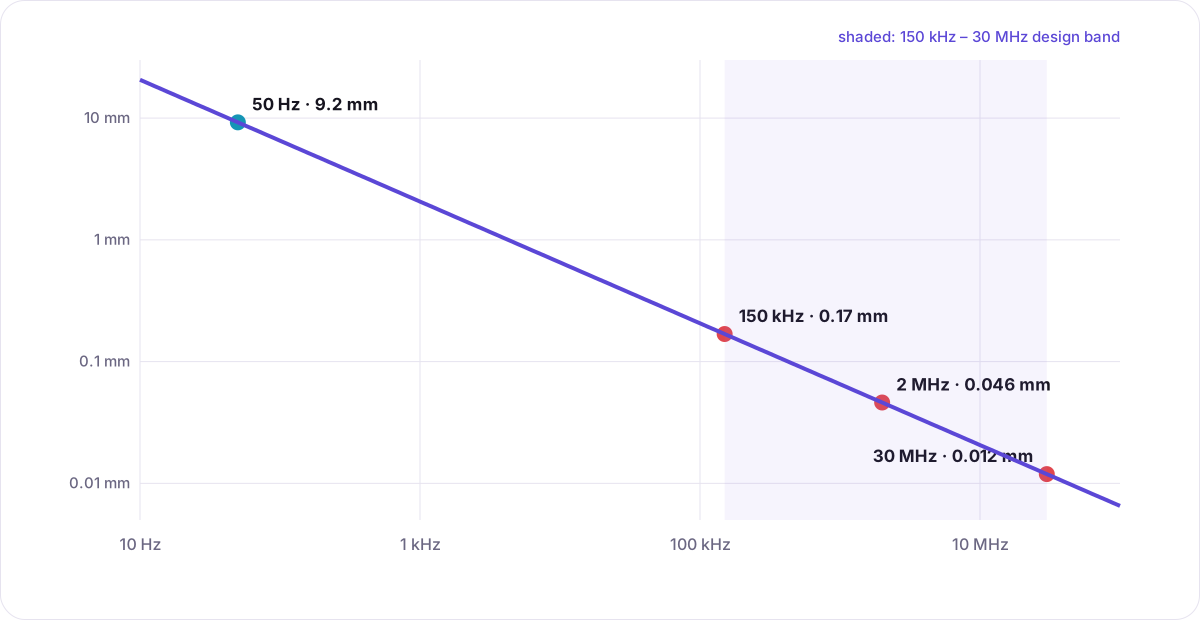 Copper skin depth from 50 Hz to 30 MHz (ρ = 1.68×10⁻⁸ Ω·m, μr ≈ 1), log–log scale.
| Frequency | Skin depth |
|---|---|
| 50 Hz | 9.2 mm |
| 150 kHz | 0.17 mm |
| 2 MHz | 0.046 mm |
| 30 MHz | 0.012 mm |
Why it matters for energy
Losses at each frequency add independently:
Because grows as the conducting skin shrinks, even modest HF currents from VFDs, inverters and SMPS generate disproportionate heat in cables, windings and transformer conductors.
Where the Denka® Platinum Plate fits
The plate is a passive, clip-on HF filter for the 150 kHz – 30 MHz band. It absorbs HF magnetic-field energy around the conductor while 50/60 Hz power passes through untouched — complementing, not replacing, IEEE 519 harmonic filters and PF-correction capacitors. Try the interactive skin-depth calculator in the Technical Portal.