Dit artikel is nog niet beschikbaar in uw taal. De Engelse versie wordt getoond.
CISPR 11 vs IEEE 519: the frequency band your harmonic filter doesn't see
Harmonic filters and PF capacitors work below 2.5 kHz. Fast power electronics emit up to 30 MHz. Three frequency regimes, three different tools.

Power-quality discussions often treat "harmonics" as one problem. In reality there are three frequency regimes, each with its own standards and mitigation tools.
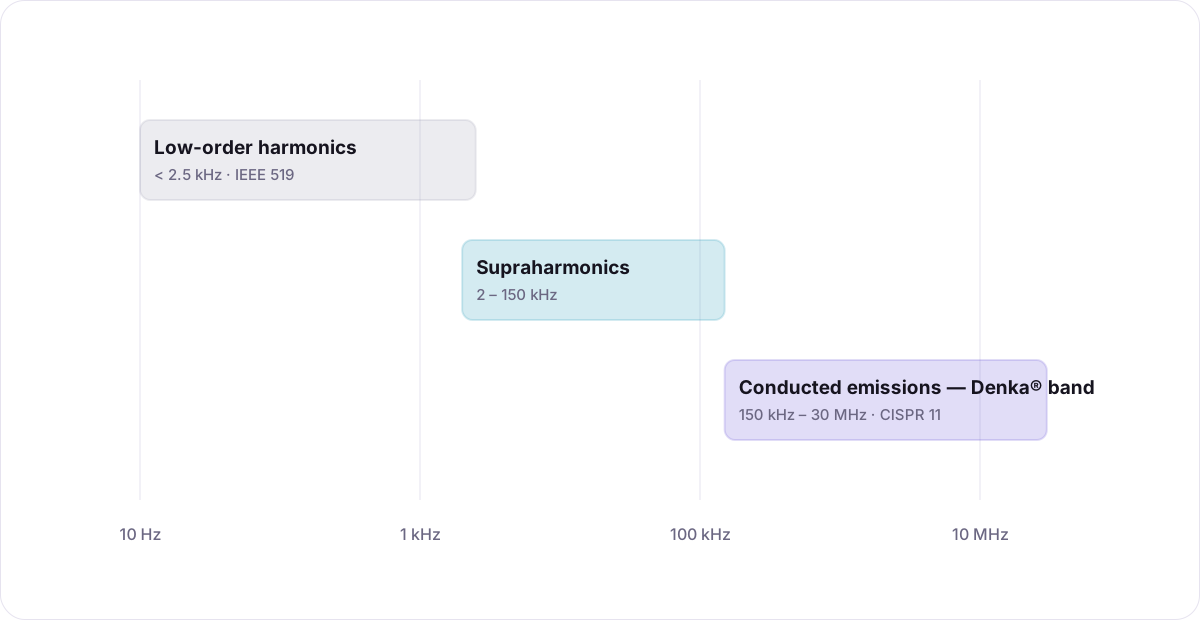 Low-order harmonics (IEEE 519), supraharmonics (2–150 kHz) and CISPR 11 conducted emissions (150 kHz–30 MHz).
1. Low-order harmonics — below 2.5 kHz
Governed by IEEE 519, typically the 5th, 7th, 11th and 13th harmonics produced by rectifiers. Mitigated by line reactors, passive or active harmonic filters and detuned PF-correction capacitors.
2. Supraharmonics — 2 to 150 kHz
An emerging regulatory range driven by PWM converters (VFD carrier frequencies of 2–16 kHz) and active front ends.
3. Conducted emissions — 150 kHz to 30 MHz
Defined by CISPR 11. Steep switching edges in VFDs, SMPS (20 kHz to several hundred kHz switching) and PV inverters produce spectra extending into the MHz range. Conventional harmonic filters are not designed for this band.
Where Denka® fits
The Black laser-engraved Denka® Platinum Plate is designed for the 150 kHz – 30 MHz band. It complements — and does not replace — IEEE 519 filters and PF correction. That is also why we report low-order THD observations (such as at Saj Ceramics) transparently as outside the plate's design band.