Cet article n'est pas encore disponible dans votre langue. Version anglaise affichée.
How to read an energy-savings claim: an IPMVP checklist for finance teams
Five questions that separate a measured saving from a sales number — and how every Denka® Platinum project is set up to answer them.

Any supplier can quote a percentage. Before you sign, ask how it was measured. The International Performance Measurement and Verification Protocol (IPMVP) and ASHRAE Guideline 14 give a simple framework.
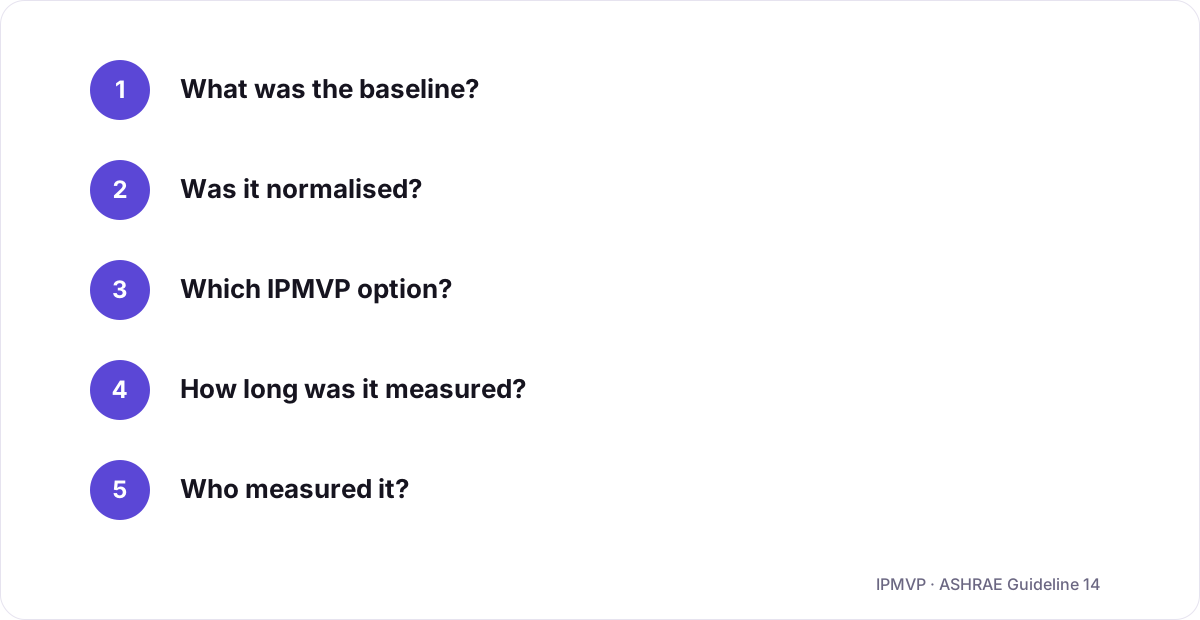 Five questions every savings claim should answer.
1. What was the baseline?
A saving is always "compared with what?". Insist on a measured baseline period before installation — not a guess.
2. Was the baseline normalised?
Production, weather and occupancy change. Good M&V normalises for them — kWh per ton, per m³ or per point of occupancy. Raw bill comparisons can overstate or understate savings.
3. Which IPMVP option?
- Option B isolates a retrofit with sub-metering.
- Option C uses whole-facility meters and is common when a measure affects many loads — as Denka® plates do.
4. How long is the reporting period?
One or two months can show direction; a full year removes seasonality. Short results should state their measurement period clearly — as every Denka® case study does.
5. Who measured it?
Third parties (such as SGS at Cleopatra Cement), plant engineers with signed attestations, or the client's own bills — each carries different weight. A credible supplier tells you which.
How Denka® applies it
Every engagement starts with a 5-step diagnostic: HF spectrum survey, thermal, power-quality and energy baselines, then post-installation verification including an ON/OFF/ON comparison under matched production.