Cet article n'est pas encore disponible dans votre langue. Version anglaise affichée.
Technique· 2 min de lecture
Complex permeability: how a ferrite passes 50 Hz and absorbs MHz noise
The real part stores magnetic energy, the imaginary part dissipates it. Why the DT400L Ni-Zn ferrite is almost invisible at 50 Hz and lossy across 150 kHz–30 MHz.
Denka® TeamIngénieurs énergie et qualité de l'énergie · Why® Group
The Denka® Platinum Plate is made of a Ni-Zn ferrite / sintered ceramic composite (grade DT400L). Its behaviour follows from one equation:
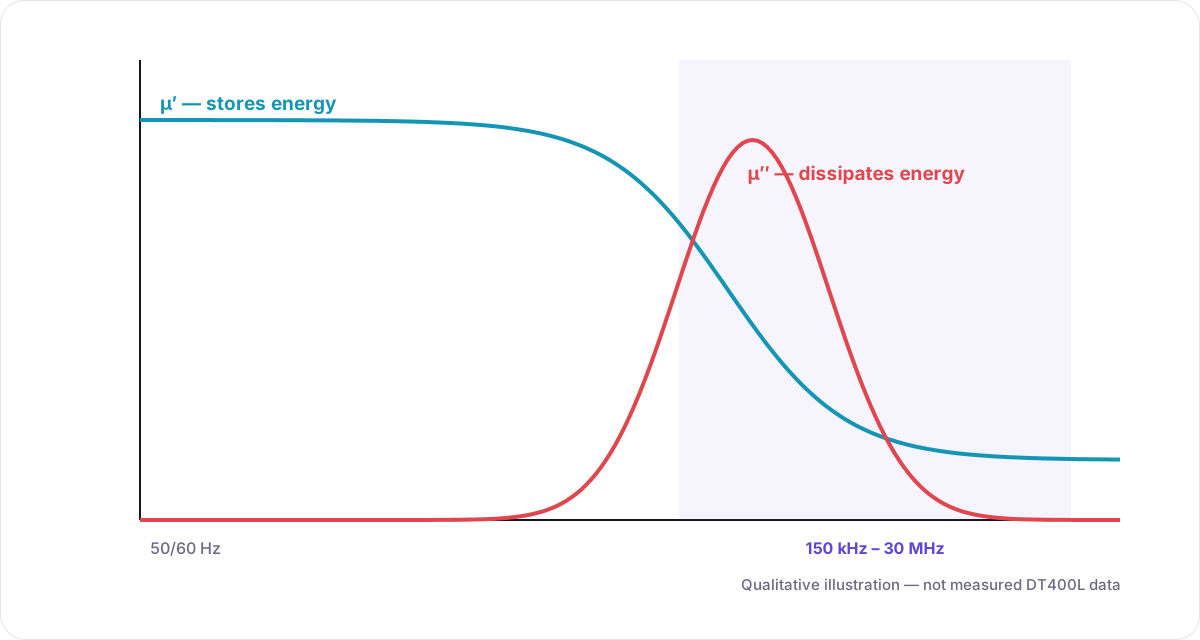 Qualitative illustration of how the storage (μ′) and loss (μ″) components behave across frequency — not measured DT400L data.
Storage vs loss
- μ′ (real part) stores magnetic energy. At 50/60 Hz it dominates while μ″ is negligible, so the added series reactance is negligible and fundamental power passes essentially unaffected.
- μ″ (imaginary part) dissipates energy. Across 150 kHz – 30 MHz it rises, so the plate behaves as a frequency-dependent resistance, converting HF magnetic-field energy into heat.
How much power is absorbed?
Two consequences follow:
- Absorption scales with , and falls with distance — so plates are clipped directly against the phase conductors.
- HF noise currents are small compared with load current, so absorbed power is small — self-heating stays at or below 0.4 °C.