Este artículo aún no está disponible en su idioma. Se muestra la versión en inglés.
Arrhenius and insulation life: why every 10 °C halves it
A few degrees of extra winding temperature sounds harmless. Under the Arrhenius rule it can take decades off a motor's insulation life.
Electrical insulation ages through chemical reactions whose rate rises exponentially with temperature. The rule of thumb used in engineering practice (IEEE Std 1-2000): insulation life roughly halves for every 10 °C rise.
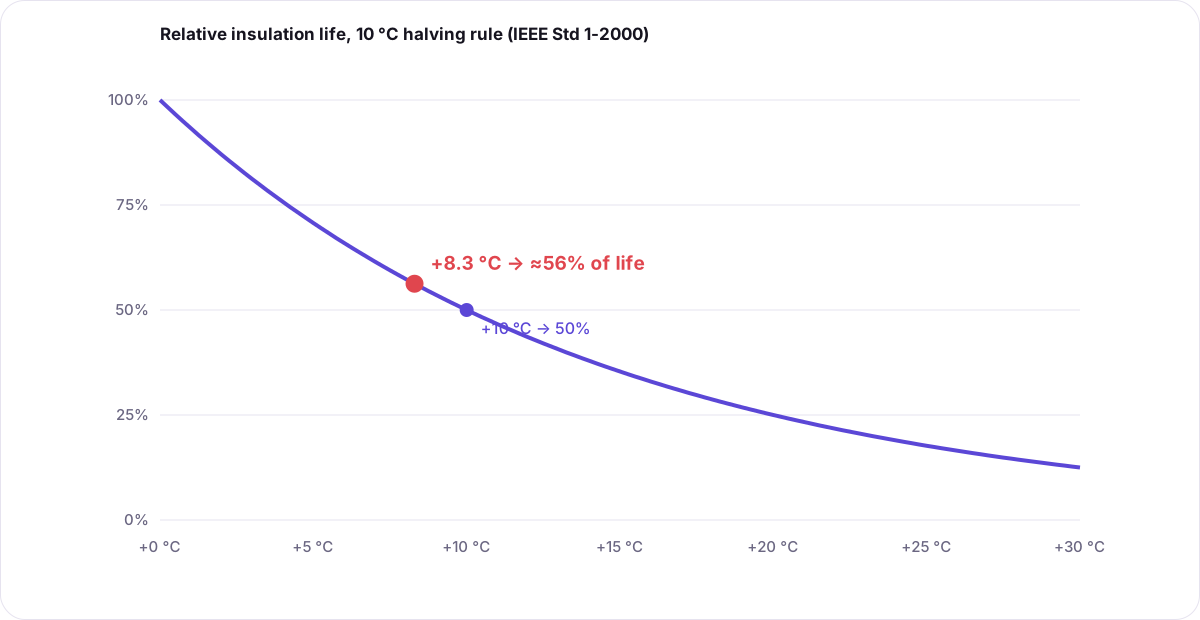 Relative insulation life under the 10 °C halving rule.
What +8 °C means
Under converter supply, studies report average winding temperature rises of about +8.3 °C (Jiang et al., 2022). Using the halving rule:
— roughly 44% less insulation life for the same duty. A 37 kW motor also loses about 41 W more for every 1 °C rise (Aarniovuori et al., 2013), so the temperature penalty is paid twice: in energy and in asset life.
Where Denka® fits
By absorbing HF conducted noise in the 150 kHz – 30 MHz band, the Denka® Platinum Plate reduces the HF component of current in cables and windings — one of the contributors to that extra heat. Thermal baselines (IR thermography) are part of every pre-installation diagnostic so the effect can be checked on site.